

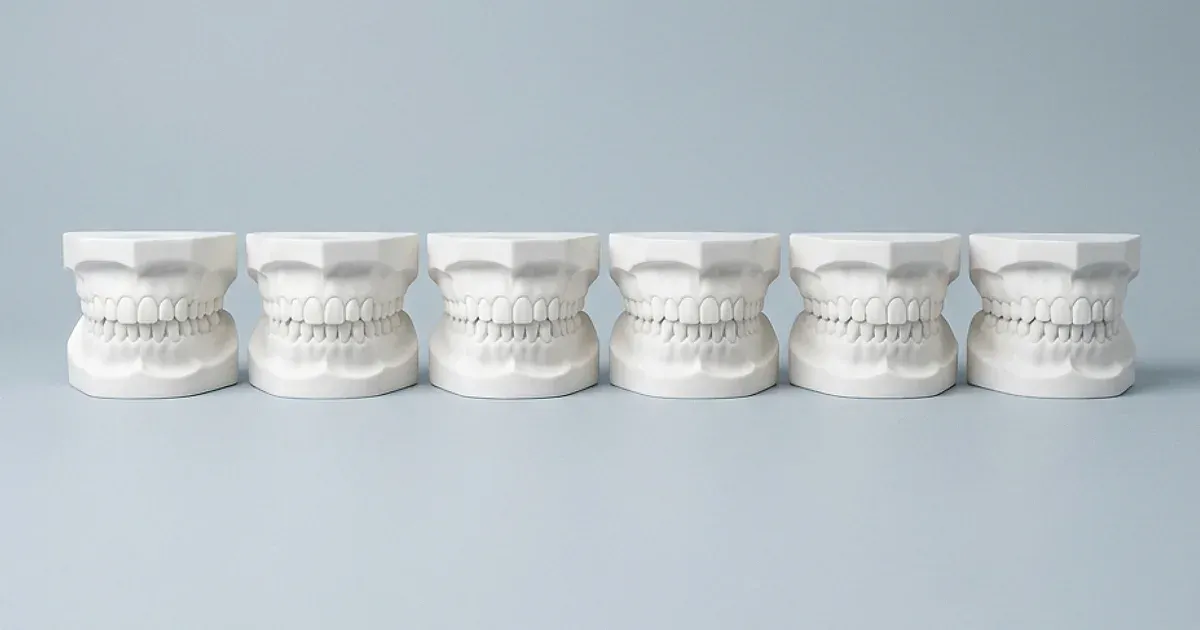
How long do you wear retainers after braces? It depends on your case, but the general pattern is the same for most people: you wear your retainer more often at first, then mainly at night, and many orthodontists recommend carrying on with night-time wear for years. The reason is simple. When braces come off or you finish your clear aligners, the bone and gums around each tooth are still adjusting to the new position, and teeth naturally try to drift back. A retainer holds them in place while that happens, and afterwards. Your orthodontist will give you a routine that fits your situation.
Why teeth shift after braces
Teeth are not fixed in the jaw like nails in a wall. They are held by elastic fibres, called the periodontal ligament, which stretch and reorganise as orthodontic treatment moves each tooth. Once treatment ends, those fibres take time to settle and keep a certain “memory” of where the teeth used to be.
Other forces keep acting on your teeth throughout life:
- pressure from your tongue, lips and cheeks;
- the way you chew and bite;
- clenching or grinding your teeth;
- natural changes in the mouth as you get older.
That is why teeth tend to move a little over time, even in people who have never had orthodontic treatment. A retainer does not correct anything new: its job is to keep the result you worked for. You can see how this stage fits into the whole process on our page about orthodontics in Benidorm.
Types of retainer: fixed and removable
There are two main families of retainer. Your orthodontist will recommend one, the other or a combination, depending on how your teeth were positioned before treatment and how your bite works.
Fixed retainer
Also called a permanent or bonded retainer, this is a thin wire glued to the inside surface of your front teeth, usually the lower ones and sometimes the upper ones too. It cannot be seen when you smile and does not rely on you remembering to wear it.
Removable retainer
This is an appliance you put in and take out yourself. The most common types are clear plastic retainers made to fit your teeth exactly, and acrylic retainers with a wire across the front. They are often worn at night.
Fixed vs removable retainer: pros and cons
There is no option that suits everyone. Each type has clear strengths and drawbacks.
Fixed retainer
Pros:
- It works around the clock without any effort from you.
- It is discreet, sitting behind your teeth.
- It cannot be lost or left at home.
Cons:
- Cleaning between those teeth is harder; you will need floss threaders or interdental brushes.
- If part of it comes loose or bends, it may stop holding the teeth without you noticing.
- It only holds the teeth it is bonded to.
Removable retainer
Pros:
- You take it out to eat and brush, so keeping your teeth clean is easier.
- It holds the whole arch, not just the front teeth.
- If it wears out or breaks, a new one can be made.
Cons:
- It only works if you actually wear it as often as you have been told.
- It can be lost, forgotten or damaged if it is not kept in its case.
- It needs cleaning every day so it does not build up deposits.
Many people end up with both: a fixed retainer on the lower teeth and a removable one on the upper teeth, or both types on the same arch.
How long should you wear retainers full time?
This is the question most patients ask, and the honest answer is that it varies. It depends on how far your teeth moved, how your bite was to begin with, your age and the health of your gums.
As a general guide:
- At first, when the movement is most recent, you are usually asked to wear a removable retainer for more hours each day.
- After that, many people switch to wearing it only at night.
- In the long term, many orthodontists recommend continuing night-time wear for years, because teeth can shift at any stage of life.
Your orthodontist will give you a specific routine and adjust it at your check-ups. Do not cut down on wear on your own, even if your teeth look stable.
How to use and look after your retainer
A few simple habits help your retainer last and do its job properly:
- Take your removable retainer out to eat and to drink anything other than water.
- Brush your teeth before putting it back in.
- Clean the retainer every day with cool or lukewarm water and a soft brush. Very hot water can warp it.
- Always keep it in its case. Wrapping it in a napkin is one of the most common ways to lose it.
- If you have a fixed retainer, pay extra attention to cleaning that area and keep up with your check-ups, as plaque build-up can affect your gums. If you notice them bleeding, you may find our page on gum treatment useful.
A common myth: “once the braces are off, treatment is over”
It is easy to think that everything ends the day your braces come off or you receive your last aligner. In reality, a stage that matters just as much begins: retention. Skipping it is one of the most common reasons teeth become crooked again over time, especially the lower front teeth. If you are still deciding how to start, our article on braces or clear aligners may help, since both systems need retention at the end.
Frequently asked questions
Do you need a retainer after braces?
Yes, in the vast majority of cases. Without retention, teeth tend to drift back towards their old position. Your orthodontist will tell you which type you need and for how long.
Is it normal for a retainer to hurt?
Feeling pressure or some discomfort when you put it in is common, especially in the first few days or if you have not worn it for a while. It usually means your teeth had moved slightly. If the discomfort does not settle, the retainer no longer fits, or it rubs and causes sores, speak to your orthodontist.
Do you have to wear retainers at night?
In many cases, yes. After the initial stage, the most common routine is to wear a removable retainer while you sleep. Your orthodontist will give you the exact schedule.
What happens if you stop wearing your retainer?
Your teeth may gradually move again, sometimes without you noticing at first. If you have stopped wearing it and it no longer fits properly, do not force it in: book a check-up so your options can be assessed.
What should you do if your permanent retainer breaks?
Do not try to reattach or cut it yourself. Book an appointment as soon as you can, because while it is loose it is not holding your teeth properly.
How much does a retainer cost?
It depends on the type of retainer and on your case. After your free initial assessment we give you an exact quote.
Every case is different
How long you wear a retainer, which type you use and how you look after it all depend on your treatment, your bite and your gums. This article offers general information only: your orthodontist will tell you what is right for you. And a tooth moving slightly is not always down to a lack of retention; it can have other causes, such as a gum problem, so it is worth having it checked by a professional.
When not to wait
Book an appointment soon if your fixed retainer has come loose or broken, your removable retainer has cracked or no longer fits, a loose wire is causing sores, or you notice your teeth shifting. The sooner it is checked, the easier it usually is to keep your result.
In the rare event that you swallow or inhale part of a retainer and have difficulty breathing, call 112 straight away.
Book your free initial assessment in Benidorm
If you have finished orthodontic treatment and have questions about your retainer, or you want to know whether your teeth have moved, Arango Dental Clinic offers a free initial assessment at our clinic in Benidorm. We will review your case and explain the orthodontic and retention options that make sense for you, and if you would also like to improve the colour or shape of your smile, we can talk about cosmetic dentistry too. You can get in touch with us to book your appointment.
This article is for general information only and does not replace a professional assessment or an individual diagnosis. Every case is different, so always follow your dentist's instructions.