

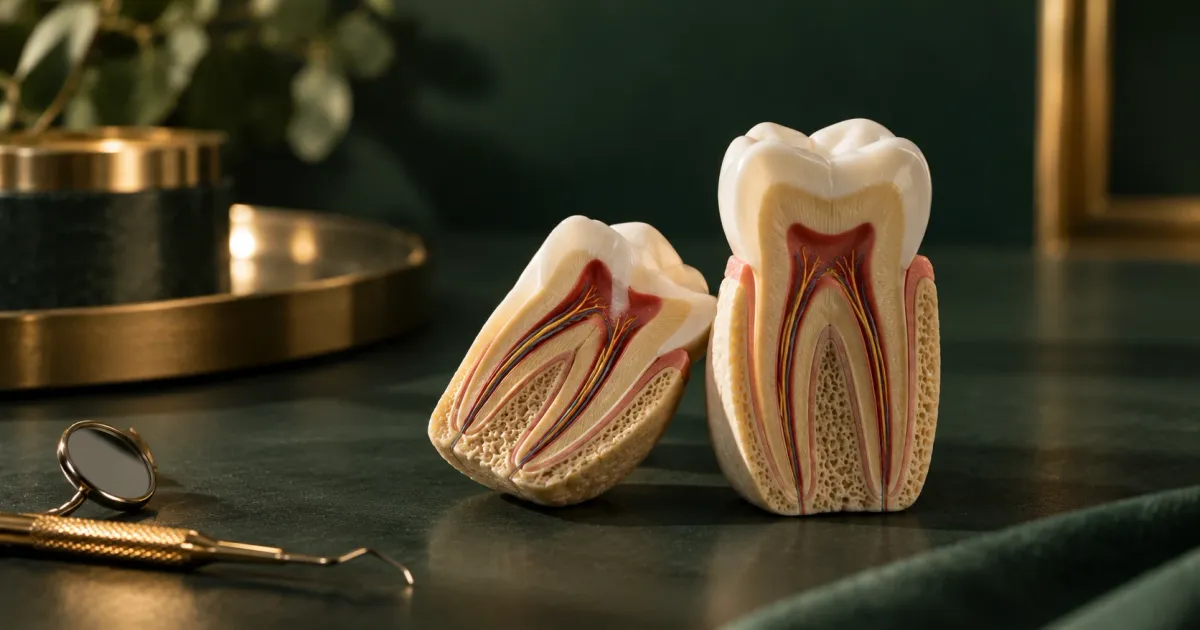
What are the signs you need a root canal? Usually, they point to the pulp inside your tooth, the soft tissue containing nerves and blood vessels, being inflamed or infected. The most common warning signs are a toothache that lingers or starts for no obvious reason, sensitivity to hot or cold that does not fade quickly, pain when you bite, a tooth that darkens, or swelling on the gum. These symptoms can also have other causes, though, and only an examination with an X-ray can show what is really going on.
Whether you live in Benidorm or are here on holiday, it is worth knowing what to look out for.
What is a root canal treatment, and why is it done?
A root canal treatment, also called endodontic treatment, involves cleaning and sealing the inside of a tooth whose pulp has been damaged. Each tooth has one or more narrow canals running down to the root. If bacteria reach the pulp, it can become inflamed or infected.
Common causes include:
- deep decay that reaches the pulp;
- a crack or fracture in the tooth;
- a knock or injury to the tooth;
- repeated dental work on the same tooth.
The aim of a root canal is to try to save your natural tooth rather than remove it. You can read more about how we approach this on our root canal treatment in Benidorm page.
Signs you may need a root canal
No single symptom on its own confirms that you need a root canal. Still, these are the signs that are worth getting checked:
- A persistent or spontaneous toothache. Pain that does not ease, that appears without you eating or drinking anything, or that wakes you at night.
- Lingering sensitivity to hot or cold. A brief twinge from an ice-cold drink is common. If the discomfort carries on after the hot or cold has gone, have it looked at.
- Pain when biting or pressing. A tooth that is tender when you chew or touch it may mean the tissues around the root are affected.
- A darkened tooth. A tooth turning grey or darker than its neighbours can be a sign of damage inside, sometimes after an old knock.
- Swelling or a small bump on the gum. Puffiness near the root, or a pimple-like bump that comes and goes, can be linked to infection.
- Tenderness in the gum. Soreness when you touch the area around one particular tooth.
Pain is not always the only sign
It is easy to assume that if the pain has stopped, the problem has gone. Sometimes the pulp is so badly damaged that it no longer causes symptoms, so the discomfort fades even though the infection may still be there. Some teeth that need treatment are only discovered at a routine check-up, when the patient has noticed nothing at all.
This is why regular check-ups matter. At our clinic we use digital dentistry, including digital X-rays and a 3D intraoral scanner, which helps us see the real condition of the tooth and the tissues around it.
These symptoms can have other causes
Sensitivity, pain when chewing or discomfort in one area does not always mean the pulp is affected. It could be down to a shallow cavity, an irritated gum, a filling that needs checking, teeth grinding or clenching, or a problem with a nearby tooth.
That is why self-diagnosis is not a good idea. Your dentist will assess your symptoms, examine the tooth and, usually, take an X-ray to decide whether a root canal is needed or whether another treatment will do.
What does a root canal involve?
Every case is different and your dentist will explain your own plan, but in general the procedure goes like this:
- Local anaesthetic is given so the area is numb during the treatment.
- The dentist opens the tooth and removes the damaged or infected pulp.
- The canals are cleaned and disinfected.
- They are filled and sealed to stop bacteria getting back in.
- The tooth is restored. A filling or, often, a crown is placed, especially on back teeth, to protect it when you chew.
Depending on the case, treatment may take more than one visit. Some tenderness in the area for a few days afterwards is normal, and your dentist will give you the advice you need. When a tooth needs a crown or a larger rebuild, this is where oral rehabilitation comes in.
A common myth: “a root canal is very painful”
This idea is still widespread, but with modern local anaesthesia the procedure is generally comfortable for most patients. In fact, the pain people remember usually comes from the infection or inflammation beforehand, not from the treatment itself. If you feel nervous, tell your dentist before you start: they can explain what you will feel and answer your questions.
Root canal or extraction? Pros and cons
When a tooth’s pulp is damaged, the two usual alternatives are a root canal treatment or taking the tooth out. You cannot always choose: it depends on how much healthy tooth is left and on the state of the root and bone.
Root canal treatment:
- Pro: it keeps your natural tooth and its root, which helps preserve your bite and the bone in that area.
- Pro: it avoids having to fill the gap a lost tooth leaves.
- Con: it may take more than one visit and often needs a crown or rebuild afterwards.
- Con: it is not possible for every tooth; if little structure remains or the root is fractured, it may not be viable.
Extraction:
- Pro: it is a more straightforward procedure on the day.
- Con: the gap usually needs filling, for example with a dental implant or a bridge, so neighbouring teeth do not drift.
- Con: over time, the bone in that area tends to shrink if the tooth is not replaced.
Your dentist will explain which options are realistic in your case.
Frequently asked questions
Root canal or filling: how do I know which I need?
A filling repairs decay that has not reached the pulp. A root canal is needed when the pulp itself is inflamed or infected. Symptoms can overlap, so only an examination, usually with an X-ray, can tell which treatment applies.
Is it normal to have pain after a root canal?
Some tenderness, especially when biting, is common for a few days while the tissues around the root settle. If the pain gets worse rather than better, or swelling appears, contact the clinic.
When can I eat after a root canal?
Wait until the anaesthetic wears off so you do not bite yourself without noticing. After that, chew on the other side until the tooth has its final restoration, because a treated tooth that is not yet protected is more fragile.
Do I need a crown after a root canal?
Often yes, especially on back teeth, because a treated tooth can become more brittle when chewing. In other cases a rebuild is enough. It depends on how much healthy tooth remains.
Is the tooth dead after a root canal?
The pulp inside is removed, so the tooth no longer has its nerve, but it stays in place, held by the surrounding tissues and bone, and can keep working normally for chewing.
What if a root canal fails?
Sometimes a treated tooth causes problems again. In many cases the treatment can be redone, and if not, other options are considered. That is why check-ups matter.
Why you should not wait
A damaged pulp does not usually heal by itself. Left alone, the infection can spread to the tissues around the root, which may complicate treatment or make it harder to save the tooth. Getting checked when the first warning signs appear generally gives you more options.
If, along with the toothache, you have a fever, swelling in the face that is spreading, difficulty swallowing or breathing, or pain that is getting worse quickly, do not wait for a routine appointment: contact the clinic or the emergency services (112) straight away.
Book your free initial assessment in Benidorm
If you have noticed any of these signs, or simply want a tooth that worries you looked at, you can book a free initial assessment at Arango Dental Clinic in Benidorm. After examining you, we will explain what we find and what options you have. The cost depends on each case and is given after that assessment. Just get in touch with the team to arrange your visit.
This article is for general information only and does not replace a professional assessment or an individual diagnosis. Every case is different, so always follow your dentist's instructions.